
 By
By 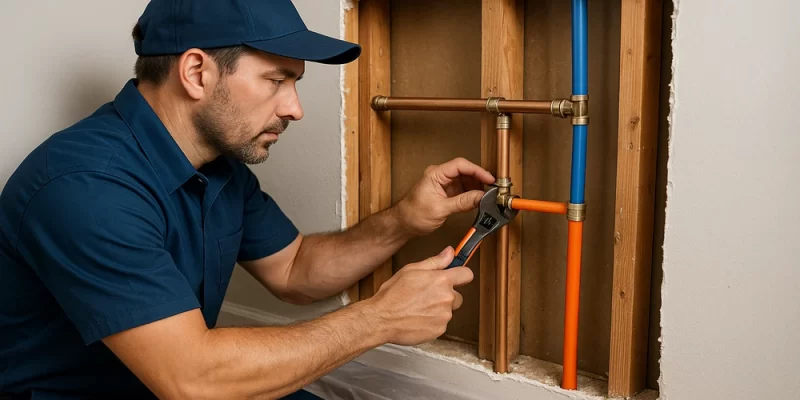
Most plumbing failures in Central Florida homes get treated as separate events. A water heater is replaced one year, a slab leak is patched a few years later, and eventually someone quotes a full repipe. In many houses, those three bills are links in a single chain that started with the water coming into the home.
That chain runs through limestone, heat, copper chemistry and the concrete slab that almost every Florida house sits on. Knowing the order in which it moves helps homeowners catch it early, when a fix costs hundreds instead of thousands. It also helps them judge whether a repair or a replacement makes more sense once the damage shows up.
The pattern is most common in neighborhoods built from the 1970s through the early 2000s, where original copper or polybutylene lines are now 25 to 50 years old. Those systems were sound when installed. Decades of mineral-heavy water and constant pressure are what wear them down.
For homeowners in Seminole and Orange counties who want the whole chain looked at in one visit, Plumber Near Me handles every link from its shop on W. 1st Street in Sanford, from slab leak detection and repiping to water softeners and tank or tankless water heaters. Bobby Lee’s crew brings more than 13 years of local experience, answers calls around the clock, and is currently taking $500 off the Halo H2 Zero whole-house filtration system through the end of October. A call to (407) 446-5220 is a good place to start.
1. It Begins in the Limestone
Central Florida drinks mostly groundwater pulled from the Floridan aquifer, which sits in limestone and dolomite. As water moves through that rock, it dissolves calcium and magnesium, the two minerals that make water hard. The USGS sorts hardness into four bands, with anything from 121 to 180 mg/L as calcium carbonate counted as hard and anything above 180 mg/L as very hard.
Readings vary by utility and even by wellfield. The most reliable number for your home is in the annual water quality report your provider is required to send. Homes on private wells, still found on larger lots in the outer parts of Seminole and Orange counties, often see heavier mineral loads plus iron and sulfur, and they get no utility report at all. A basic lab test fills that gap.
2. Scale Settles Where Water Gets Hot
Heat pushes minerals out of solution, so the water heater is usually the first appliance to show wear. In a tank model, scale flakes collect at the bottom and insulate the water from the burner or lower element. The tank starts to rumble or pop as water trapped under the sediment boils, recovery slows, and the bottom eventually corrodes through.
Tankless units suffer in a different way. Scale coats the narrow passages of the heat exchanger, which brings on error codes and lukewarm swings mid-shower. Most manufacturers call for descaling once a year in hard water areas, and warranty coverage can hinge on it. The efficiency case for tankless still holds, since the U.S. Department of Energy estimates they can be 24 to 34 percent more efficient than a tank for homes using 41 gallons or less of hot water a day. That gain only lasts while the exchanger stays clean.
3. Copper Loses Its Wall From the Inside
Once minerals and disinfection chemistry flow through the lines every day, copper begins to thin. Pitting corrosion carves small cavities into the inner wall, often near fittings, elbows and on the hot side, where higher temperature speeds the reaction. High velocity in undersized lines and stray electrical current from grounding problems can make it worse.
The result is the pinhole leak, a spray so fine it can soak drywall for weeks before anyone notices. One pinhole is a repair. Three or four within a few years usually means the pipe wall is thin throughout the house.
Homes with polybutylene, the gray plastic pipe used from roughly 1978 to 1995, face a related problem. The material and its fittings break down with age and exposure to chlorinated water, and failures tend to be sudden rather than slow.
4. The Leak Moves Under the Concrete
Nearly every Central Florida home is built slab on grade, with water lines running through or beneath the foundation. When a weakened line fails there, nothing drips from a ceiling. The clues are subtler: a warm patch of tile over a hot line, the hiss of running water with every fixture off, a cracked floor tile, mildew along a baseboard, or a water heater that cycles when nobody is using hot water.
The water meter is the cleanest test. Turn off every fixture and watch the leak indicator for 15 minutes. If it moves, water is going somewhere. EPA WaterSense figures put the average household’s leaks at more than 9,300 gallons wasted every year, and a pressurized slab leak can top that on its own while washing out the soil that supports the foundation.
5. Pinpointing Comes Before Any Jackhammer
Modern slab leak detection keeps demolition small. Technicians isolate the hot and cold sides with pressure tests, then trace the failing segment using acoustic listening equipment and thermal imaging. A good locate narrows the break to a spot just a few feet wide.
From there, homeowners usually have three paths. A spot repair opens the slab directly above the leak, which is fast but leaves a floor patch. Tunneling in from outside spares interior flooring, though it costs more. Rerouting abandons the under-slab line and runs new pipe through the walls and attic. That last option often makes the most sense when the pipe in the slab is the same age as the pipe that just failed.
6. The Repipe, and Protecting What Comes Next
A second slab leak within a few years, repeated pinholes, discolored water or falling pressure across the house all point toward a whole-house repipe rather than another patch. Most Central Florida repipes now use PEX, which handles hard water well and bends around framing with fewer fittings. CPVC is still installed, but it grows brittle with age and attic heat, so routing and support matter more.
The step homeowners tend to skip is treating the water that will run through the new pipe. A softener or whole-house filtration system at the point of entry slows the same scale and chemistry that wore out the old lines. It also protects the water heater, fixtures and appliances on the same run. Pairing a repipe with water treatment means the chain starts over on far better terms than it did the first time.




Comments